The Historic Upset - How Summer 2026 Dramas Smashed Multi-Season Winter Titans
Watch Turkish Dramas Securely
Ready to watch? Don't let your ISP throttle your speed or block local Turkish channels. Stream your favorite series in full HD securely from anywhere.
For decades, every devoted follower of Turkish television understood an ironclad industry rule: summer series were temporary snacks, while winter dramas were the untouchable kings.
Every June, television networks would fill the empty airwaves with sunny romantic comedies or light teen projects. They had modest budgets, enjoyed a couple of months of easy ratings during prime-time vacation mode, and were expected to quietly pack up and disappear by mid-September. The moment high-budget winter behemoths returned with their explosive season premieres, summer productions were routinely swept aside without mercy.
September 2026 did not just challenge that traditional rule. It utterly demolished it.
In what can only be described as a seismic earthquake across the Turkish ratings landscape, two summer projects from the 2026 class did something that industry veterans believed was mathematically impossible. They did not merely survive the September winter transition; they stepped directly into the arena against multi-season television monsters and claimed the undisputed crown.
We are talking about the unprecedented triumphs of Daha 17 on Sunday nights and Altı Üstü İstanbul on Monday nights.
Here is the exclusive Vartolo breakdown of how the old television hierarchy collapsed in front of our eyes.
1. The Sunday Night Massacre: How "Daha 17" Shocked the Untouchable "Teşkilat"
Sunday evenings on Turkish television have belonged to one show for six straight years: the TRT 1 flagship intelligence and military thriller Teşkilat. Through multiple cast transformations, high-stakes geopolitical scripts, and massive state-funded action set-pieces, Teşkilat entered its seventh season as the undisputed ruler of the weekend. Nobody dared to challenge it.
When Kanal D launched its youth mystery drama Daha 17 in late May, critics expected it to be a summer placeholder that would fold the second Teşkilat returned for Season 7.
Then came Sunday, September 20, 2026.

When the official numbers rolled in on Monday morning, industry executives rubbed their eyes in disbelief. As shown in the official ratings data above, the Season 7 premiere of Teşkilat slumped to 3.95 in Total (Rank 3), 3.53 in AB, and 3.78 in ABC1. For a flagship drama that routinely pulled numbers above 5.50 and commanded the Sunday night throne for half a decade, this was an alarming stumble.
And where did the audience go? Straight to Kanal D.

The official broadcast data confirms the scale of this upset: airing its 17th episode on that exact same night, Daha 17 scored a breathtaking 7.05 in Total (Rank 1), 6.00 in AB (Rank 1), and 6.86 in ABC1 (Rank 1) with an astonishing 23.50% Total audience share. A summer youth drama did not just outshine the national intelligence giant; it doubled its audience across every demographic group.
Why Did Daha 17 Conquer Sunday Night?
- Character Investment Over Formula Fatigue: By Episode 17, viewers were deeply invested in the tragic quest of Aras (Çağan Efe Ak) to uncover the truth behind his lost brother inside the sinister Akkaya empire. While Teşkilat repeated its familiar formula of undercover operations and geopolitical villainy, Daha 17 kept raising the emotional stakes with unpredictable twists.
- The Emre Kabakuşak Touch: Director Emre Kabakuşak, famous for Sen Anlat Karadeniz and Sefirin Kızı, treats youth drama with the heavy dramatic seriousness of an epic tragedy rather than a shallow teen romp.
- The Matriarch Factor: With Nesrin Cavadzade delivering magnetic performances week after week, older demographics that traditionally tuned in to political thrillers switched channels to follow the psychological warfare in Bodrum.
2. Monday Night Carnage: "Altı Üstü İstanbul" Overthrows the "Uzak Şehir" Reign
If Sunday night was an upset, Monday night was an absolute shockwave that reverberated through every production house in Istanbul.
For two consecutive seasons, Uzak Şehir (The Far City) was Kanal D crown jewel. Adapted from the Middle Eastern blockbuster Al Hayba, the intense saga of Cihan Albora (Ozan Akbaba) and Alya (Sinem Ünsal) was a certified juggernaut. On Monday nights, Uzak Şehir was widely regarded as an impenetrable fortress that crushed any competing drama attempting to air against it.
Entering Season 3 with an expensive, highly publicized international storyline filmed on the bridges of Budapest, Hungary, everyone assumed Kanal D would clean up Monday night with ease.
Instead, ATV neighborhood street drama Altı Üstü İstanbul showed zero fear.

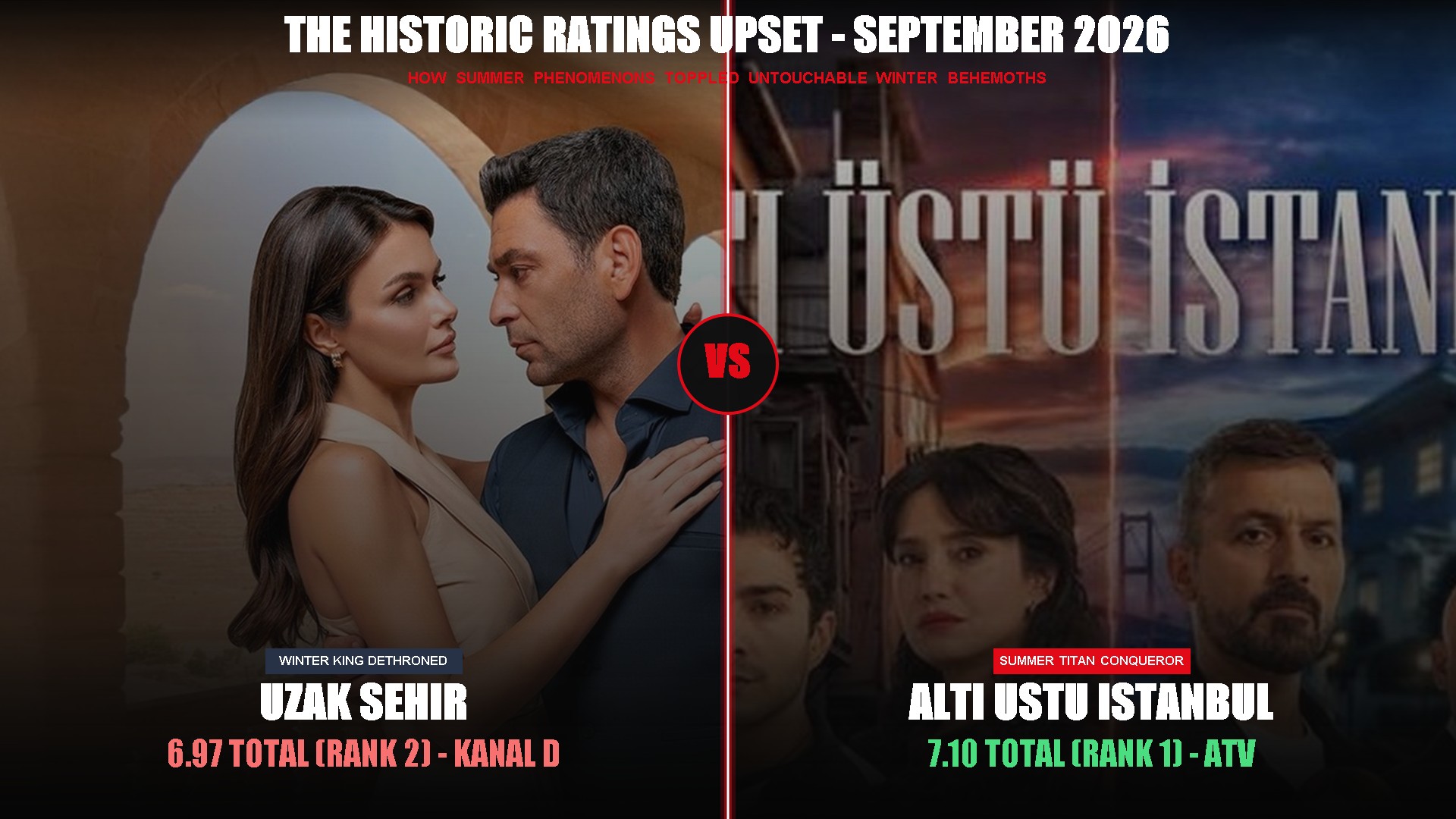
Looking at the evidence from Monday, September 21, 2026, Uzak Şehir Season 3 Episode 2 delivered a strong 6.97 in Total (Rank 2), with 5.69 in AB and 6.47 in ABC1. Under normal circumstances, nearly 7 points in Total guarantees an easy first-place finish.
Yet it was not enough to hold the throne.

The official table above shows the historic turnaround: in its 15th episode, Altı Üstü İstanbul surged ahead with a phenomenal 7.10 in Total, capturing the coveted Number 1 rank on Monday prime time with a dominant 23.05% share.
A summer production about street kids and football dreams walked right into the den of the Albora clan and took the crown.
The Street Realism Revolution
Why did Altı Üstü İstanbul manage to topple a giant that looked untouchable just a few months ago?
The secret lies in the writing duo of Yekta Torun and Hilal Yıldız (the minds behind Tozluyaka and Kırgın Çiçekler). While Uzak Şehir shifted gears into European intrigue with Alya and Enver in Budapest, Altı Üstü İstanbul doubled down on raw, dusty Turkish neighborhood reality in Ziyankâr Mahallesi.
Turkish television audiences have always possessed an emotional soft spot for brotherly sacrifice. When Emir (Rahimcan Kapkap) bleeds for his neighborhood and carries the heavy burden of family survival alongside titans like Feyyaz Duman and Nehir Erdoğan, the emotional resonance is immediate. Viewers connected with the raw heart of the streets over distant European chases.
3. The Vartolo Theory: Why Are Winter Audiences Switching Sides?
Here at Vartolo, we track every shift in the Turkish dizi ecosystem, and what happened this September is not a fluke or a lucky week. It represents a fundamental shift in how Turkish audiences consume weekly television.
1. The Summer Transition Advantage
In the past, summer series were lightweight comedies that had nothing in common with heavy winter dramas. When autumn arrived, viewers who craved serious storytelling naturally returned to their favorite winter titles.
In 2026, the strategy changed completely. Altı Üstü İstanbul and Daha 17 were never romantic comedies. They were built from day one as dark, gritty, high-stakes dramas with deep mysteries and serious emotional stakes. By the time September rolled around, these two shows already had 15 to 17 episodes of momentum, complex lore, and bonded audiences who were unwilling to abandon them.
2. The Multi-Season Fatigue Trap
Long-running shows like Teşkilat (entering Season 7) and Uzak Şehir (entering Season 3) face the dreaded curse of repetition.
When a series runs for hundreds of hours, writers often fall into familiar cycles: kidnapping plots, sudden amnesia, or forced separations to artificially delay emotional payoffs. Modern Turkish audiences have sharp instincts. When they sense that a story is running in circles just to keep cameras rolling, they will gladly jump ship to a fresher show where every week delivers genuine progression and real stakes.
3. Star Power Alone No Longer Guarantees Victory
For years, casting famous faces and throwing massive budgets at cinematic locations was enough to keep a winter show in first place. But the numbers from September 20 and 21 prove that flashy names cannot compensate for emotional detachment.
Viewers chose the underdog brotherhood in Ziyankâr and the intense mystery in Bodrum over big-budget formulas that felt like they had already said everything they needed to say seasons ago.
The Bottom Line: A Historic Precedent
Make no mistake: we are witnessing a turning point in modern Turkish television history.
Never before in the modern ratings era have two summer-born productions maintained enough dramatic velocity to march straight into mid-September and dethrone multi-season flagship dramas on their home turf.
Daha 17 holding over 7.00 against the return of Teşkilat, and Altı Üstü İstanbul taking the Number 1 spot over Uzak Şehir, is a clear message to network executives across Turkey: the season label means nothing anymore. Great writing, relentless momentum, and genuine emotional catharsis will defeat any legacy title, any day of the week.
Winter titans can no longer rely on their past glory. The summer champions have taken the throne, and they have no intention of giving it back.